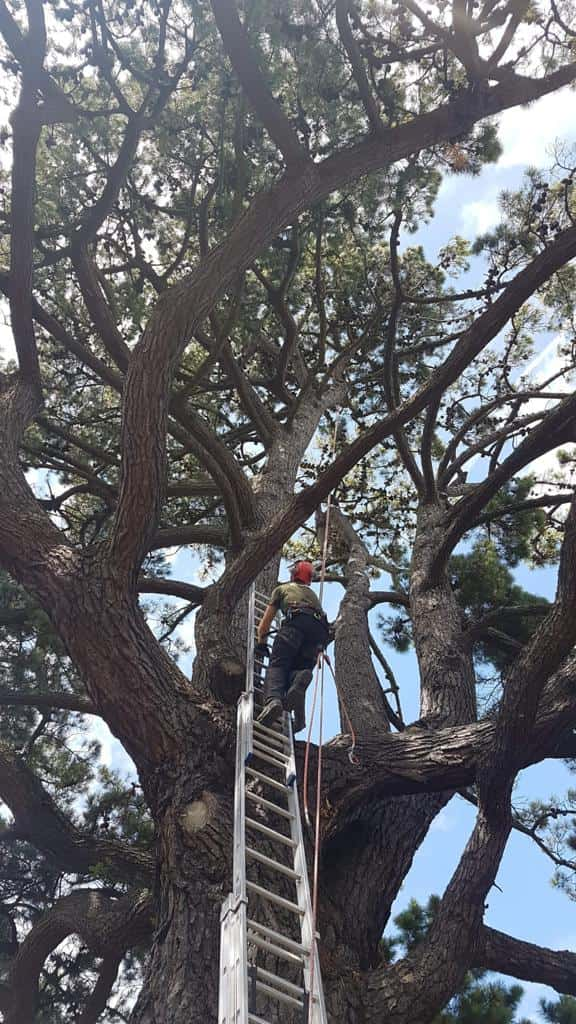
Large, established trees can add character and maturity to a garden, but their size can become difficult to accommodate when the available outdoor space is limited. Wide canopies, low branches and dense growth can make a small garden feel enclosed, reduce usable areas and restrict the amount of space available beneath and around the trees.
For homeowners in Nazeing, Essex, creating more usable garden space does not necessarily mean removing large trees. Professional tree surgery can often manage particular parts of a canopy, improve clearance and bring excessive growth back into proportion while retaining suitable trees.
The key is to identify exactly what is making the garden feel restricted. Once the problem has been assessed, appropriate pruning, crown management or selective branch removal can be used to improve the relationship between the trees and the space around them.
How Can Professional Tree Surgery Make a Small Garden Feel More Spacious?
Tree surgery can create more usable space by managing the parts of a tree that have become disproportionate to their surroundings.
This might involve reducing excessive crown spread, raising selected lower branches, pruning overextended limbs or managing several trees whose canopies have begun competing for the same limited space.
The objective should not simply be to remove as much growth as possible. Effective tree management focuses on the specific branches or sections responsible for the problem while retaining suitable growth elsewhere.
Start by Identifying What Is Restricting the Garden
A large tree can dominate a small garden without necessarily requiring substantial work.
Before deciding on pruning, it helps to establish exactly what is creating the sense of limited space.
The problem may be:
- Low branches restricting movement
- A canopy extending across much of the garden
- Several trees overlapping one another
- Individual branches projecting into useful areas
- Dense growth making the garden feel enclosed
- Limited clearance around patios or paths
- A tree that has become disproportionately large for its position
Different problems require different approaches. Identifying the actual restriction helps avoid unnecessary pruning.
Large Trees Do Not Automatically Need to Be Felled
When a mature tree occupies a significant proportion of a small garden, complete removal may initially seem like the obvious way to regain space.
However, size alone does not necessarily make felling appropriate.
If the tree remains suitable for its position and the main issue is excessive crown growth, professional pruning may significantly improve the usable area without removing the tree altogether.
Assessment should therefore consider whether the problem can be resolved through proportionate management before felling is considered.
Crown Reduction Can Manage Excessive Spread
Crown reduction decreases the overall dimensions of a tree canopy by shortening selected branches back to appropriate growth points.
In a small garden, reducing excessive lateral spread can be particularly useful.
A tree whose branches have gradually extended across much of the available space may feel considerably less dominant after an appropriately planned reduction.
Professional crown reduction should maintain a balanced form rather than simply cutting every branch back to the same boundary.
Reducing Height and Reducing Spread Are Not Always the Same Thing
Homeowners sometimes assume that a large tree needs to be made shorter when the real problem is its width.
If branches are occupying usable garden space at lower or intermediate levels, reducing height alone may make relatively little difference.
A professional assessment considers which dimensions are actually causing the problem.
In some cases, lateral reduction may provide the greatest practical improvement. In others, a more general crown reduction may be appropriate.
The pruning specification should respond to the individual tree and garden rather than relying on a standard approach.
Crown Lifting Can Improve Space Beneath a Tree
Low branches can make a small garden feel particularly confined.
Where suitable for the tree, crown lifting involves removing or managing selected lower branches to increase clearance beneath the canopy.
This can make it easier to use areas around paths, lawns and other parts of the garden without necessarily reducing the entire crown.
The amount of crown lifting needs careful consideration. Removing too many lower branches can alter the tree’s natural proportions, so the work should remain appropriate for the individual tree.
Selective Pruning Can Solve Specific Problems
Sometimes the overall size of the tree is not the real issue.
One or two branches may extend directly across the most useful section of the garden while the remainder of the canopy causes little inconvenience.
In this situation, selective pruning can be more appropriate than reducing the complete crown.
By concentrating on the branches responsible for the restriction, more of the established canopy can be retained.
This targeted approach is often particularly useful in smaller gardens where gaining even a modest amount of additional clearance can make a noticeable difference.
Overextended Branches Can Make a Garden Feel Smaller
Branches do not always develop evenly.
Some can extend much further than neighbouring growth, particularly where they have developed towards available light or open space.
A single overextended limb can occupy a surprisingly large portion of a small garden.
Shortening suitable branches back to appropriate pruning points can restore more balanced proportions and create additional space without dramatically changing the complete tree.
Several Tree Canopies Can Merge Together
Where multiple large trees surround a relatively small garden, their individual canopies may gradually begin overlapping.
The result can be a continuous mass of foliage rather than clearly defined individual crowns.
This can make the garden feel more enclosed and can complicate decisions about which tree requires attention.
Professional assessment can consider the trees together rather than treating each one in isolation.
Selective work across several crowns may sometimes provide a more balanced result than heavily reducing one tree while leaving all surrounding growth untouched.
Each Tree Should Still Be Assessed Individually
Even where several trees contribute to the problem, they should not automatically receive identical pruning.
Different species grow differently and can respond differently to tree surgery.
One tree may benefit from modest crown reduction, another may only need selective branch pruning, while a third may require little intervention.
A coordinated plan can manage the garden as a whole while respecting the individual characteristics of each tree.
Dense Growth Can Make the Garden Feel Enclosed
The physical dimensions of a canopy are not the only factor influencing how spacious a garden feels.
Very dense growth can create a strong sense of enclosure.
Where appropriate for the tree, selective crown management may help improve the relationship between the canopy and the space beneath it.
However, removing excessive internal growth simply to create the most open possible crown is not necessarily desirable.
Professional tree surgery should retain an appropriate structure while achieving the practical improvement required.
More Light Can Change How the Garden Feels
A garden surrounded by substantial tree canopies can sometimes feel smaller because large areas remain shaded.
Appropriate pruning may alter the amount and distribution of light reaching parts of the garden, although the effect will depend on the position, density and number of trees.
Tree surgery should not be approached as a guarantee of constant sunlight.
Instead, pruning can manage excessive growth and improve canopy proportions, which may allow the surrounding space to feel more open.
Clearance Around Paths Can Improve Usability
Low or projecting branches can make paths feel narrower than they actually are.
People may need to duck beneath growth or walk around branches, reducing the practical width of the route.
Selective pruning can improve clearance without necessarily changing the overall size of the tree substantially.
In a small garden, these relatively modest changes can have a significant effect on how comfortably the space can be used.
Patio Areas Can Benefit From Better Canopy Management
A large tree extending heavily across a patio can make an otherwise useful area feel confined.
The solution does not necessarily involve removing every branch above the paving.
Instead, the canopy can be assessed to identify whether selected limbs are responsible for excessive encroachment.
Where appropriate, pruning these sections can create improved separation between the tree and the usable garden area while retaining suitable surrounding growth.
Garden Boundaries Can Become Easier to Maintain
Large trees close to the edges of a small garden can develop branches that extend widely along or across boundaries.
Where this growth becomes excessive, accessing and maintaining the surrounding garden can become more difficult.
Selective reduction can help bring suitable branches back into proportion.
The aim should be practical management rather than trying to force a mature tree into an unnaturally small shape.
Removing Deadwood Can Improve the Canopy
Dead branches can accumulate within mature trees.
Although deadwood removal does not necessarily reduce the overall size of the crown substantially, it can form an important part of professional tree maintenance.
Where appropriate, removing significant dead branches can improve the condition of the managed canopy and address particular areas requiring attention.
Deadwood should be distinguished from healthy growth so that unnecessary live branches are not removed simply to make the tree appear smaller.
Previous Pruning Can Influence What Is Possible
Trees that have undergone repeated pruning may have developed a canopy very different from their original natural structure.
Old pruning points can produce dense regrowth, and repeated heavy cutting can create clusters of vigorous shoots.
Before reducing the tree again, these previous interventions should be assessed.
Simply repeating the same cuts may encourage another cycle of rapid growth.
Professional tree surgery considers the existing structure and how the tree is likely to respond after further pruning.
Cutting Trees Back Too Hard Can Be Counterproductive
It can be tempting to request an extremely heavy reduction in the hope of creating the maximum amount of garden space.
However, excessive pruning is not necessarily an effective long-term strategy.
Some trees respond to substantial canopy loss by producing vigorous new growth. The resulting shoots can develop quickly and may create another dense canopy requiring further management.
A proportionate reduction seeks to create useful improvement while retaining suitable structure and healthy foliage.
Creating Space Is About Better Proportions
A successful result does not necessarily mean making every surrounding tree dramatically smaller.
Often, the objective is to restore a more appropriate relationship between the trees and the garden.
Removing selected low branches, shortening overextended limbs and reducing excessive spread can change how the space functions without transforming the trees unnecessarily.
This measured approach can be particularly effective where mature trees remain valued features of the garden.
Professional Pruning Can Preserve the Character of Mature Trees
Large established trees can contribute significantly to the character of a garden.
Removing them purely to create additional open space can produce a much greater change than anticipated.
Where retention is practical, professional pruning provides an opportunity to preserve that established character while addressing the aspects of growth that are causing difficulty.
This balance between retention and usability is one of the main advantages of careful tree management.
Not Every Tree Needs Work at the Same Time
If several large trees surround a small garden, it may seem logical to reduce all of them.
That is not always necessary.
One tree may be responsible for most of the unwanted shade or physical obstruction, while another contributes relatively little to the problem.
Assessment can identify where intervention will provide the greatest practical benefit.
This avoids unnecessary work and allows suitable trees or branches to remain untouched.
Tree Felling May Sometimes Be Appropriate
Although professional pruning can solve many space-related problems, there are situations where tree removal deserves consideration.
A tree may no longer be suitable for its position, its condition may have deteriorated significantly, or retaining it could require repeated substantial intervention without achieving a satisfactory result.
Felling should follow an assessment of the individual tree and available alternatives.
Where crown management can provide a suitable outcome, removal may be unnecessary. Where it cannot, felling may form part of a wider plan for improving the garden.
Stumps Should Be Included in Future Garden Plans
If a tree is removed to create more usable space, the remaining stump should also be considered.
A stump can restrict landscaping, interfere with lawn development or prevent the area from being incorporated into a new layout.
Stump grinding can reduce this obstruction and make the former tree position easier to integrate into future garden plans.
Thinking about the stump before felling provides a clearer idea of how the area will function once the tree has been removed.
Consider How the Garden Will Be Used Afterwards
Tree work is most effective when there is a clear objective.
Rather than simply asking for the trees to be made smaller, consider how you would like to use the space.
You may want:
- Better clearance around a seating area
- More accessible paths
- Additional usable lawn
- Less canopy extending across the centre of the garden
- Better separation between trees and garden features
- A more open feeling without removing established trees
- Space for future landscaping
These objectives can help guide the tree surgery specification.
Long-Term Management Is Better Than Repeated Severe Cutting
Trees continue growing after pruning.
A crown that has been reduced will gradually increase in size again, and selectively pruned branches will produce new growth.
For this reason, creating usable space should be considered as part of long-term tree management.
Periodic assessment can identify when further proportionate work is appropriate.
Managing growth before it becomes excessively difficult to accommodate can reduce the need for severe interventions later.
Professional Assessment Helps Identify the Best Combination of Work
Where several mature trees surround a confined garden, deciding what to prune can be more complicated than it initially appears.
A professional tree surgeon can assess:
- The species and condition of each tree
- Overall crown dimensions
- Low branches
- Overextended limbs
- Areas where canopies overlap
- Previous pruning
- The amount of available garden space
- Clearance around paths and other features
- Which trees are actually creating the main restrictions
- How each tree is likely to respond to pruning
This information can then be used to develop a proportionate approach.
The Best Solution May Involve Several Small Changes
Creating more usable space does not always require one dramatic intervention.
A modest crown reduction to one tree, selective pruning to another and crown lifting elsewhere may collectively transform how a small garden functions.
This can provide a more balanced result than heavily reducing every tree.
Professional tree surgery is valuable because different techniques can be combined according to what each part of the garden actually requires.
Professional Tree Surgery in Nazeing, Essex
At Nazeing Tree Surgeons, we assess large trees in relation to the space surrounding them before recommending the appropriate work.
Where mature trees are making a small garden difficult to use, the objective is to identify which parts of the canopy are responsible and determine whether crown reduction, selective pruning, crown lifting or another form of tree management can provide the required improvement.
For homeowners in Nazeing, Essex, professional tree surgery can help create a more practical relationship between established trees and limited garden space without automatically resorting to unnecessary removal.
Conclusion
Large trees surrounding a small garden can make the available space feel restricted, particularly when canopies overlap, branches extend across usable areas or low growth reduces clearance. However, creating more space does not necessarily mean removing the trees.
Professional crown reduction, selective pruning and carefully planned crown lifting can often manage excessive growth while retaining suitable mature trees. In gardens containing several trees, different techniques may be appropriate for each one rather than applying the same treatment throughout.
The most effective approach starts by identifying exactly which branches, trees or canopy areas are limiting the garden and then carrying out proportionate work to address them.
If large trees are making your garden in Nazeing, Essex feel increasingly difficult to use, contact Nazeing Tree Surgeons. We can assess the trees and recommend appropriate tree surgery to improve the available space while retaining suitable growth wherever practical.
Call us on: 01992 932 997
Click here to find out more about Nazeing Tree Surgeons
Click here to complete our contact form and see how we can help with your tree care needs.